
Benin
In Benin, HI works to improve the quality of life of people with disabilities and promotes their full participation in the country’s economic and social life.
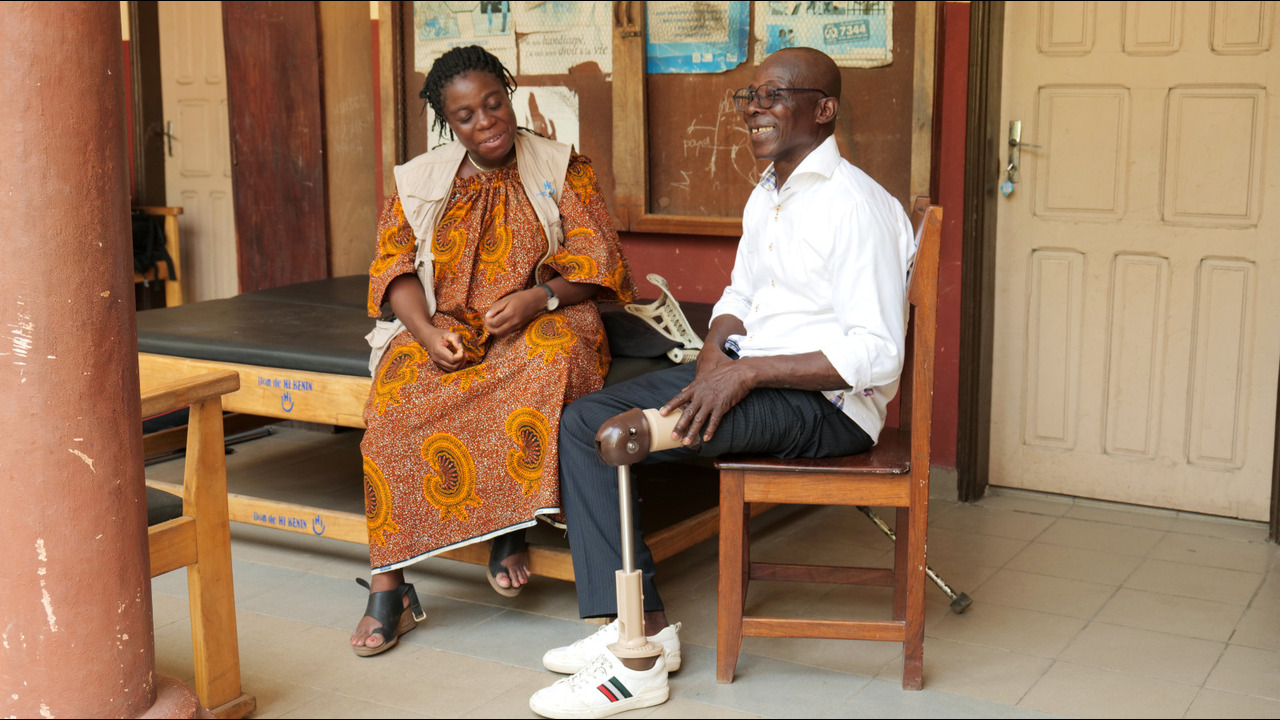
Souleyman Lawani talks to Prunelle Togni, physiotherapist and rehabilitation officer for HI, during a check-up of his prosthesis. | © A. Stachurski / HI
Actions in process
HI works to improve the employment and economic inclusion of people with disabilities in Benin through awareness-raising, training and advocacy. To this end, the organisation helps people with disabilities to secure jobs in both the private sector and the civil service. HI also supports the creation of inclusive businesses and develops support mechanisms and financial assistance for people with disabilities. The organisation places particular emphasis on training young people and women and ensuring their inclusion in promising sectors such as agriculture and renewable energy. The organisation works in partnership with the authorities, businesses and training centres to increase the participation of people with disabilities in the political debate and to support advocacy efforts aimed at ensuring their long-term integration into the labour market.
In the north of the country, which has been affected by the spread of the Sahelian crisis and insecurity, HI works alongside displaced people and host communities to improve their living conditions and strengthen social cohesion. To this end, the organisation supports the development of new economic opportunities, particularly for young people and women. Awareness-raising campaigns are also organised and focal points trained to strengthen dialogue and the participation of all members in community life.
In a country where access to healthcare remains unequal, HI carries out activities to improve access to rehabilitation, particularly for those in vulnerable circumstances. Road safety awareness campaigns are organised in partnership with road safety clubs and associations. Support for rehabilitation services is provided to road traffic accident victims in order to break the cycle of motor disabilities and facilitate the functional independence of those involved in accidents. This project is carried out in close collaboration with the Ministries of Health and Social Affairs, associations of rehabilitation professionals and health centres. Training courses are also organised for healthcare professionals to improve the interdisciplinary nature of care and raise awareness of the benefits of rehabilitation following a road traffic accident.
HI partners with organisations representing women with disabilities and civil society groups that campaign against violence against women and girls, particularly those with disabilities. The organisation supports them through training and the sharing of best practice, to maximise the impact of their actions and strengthen their participation in public debate and political decision-making.
- Number of HI staff: 61 people
- Number of direct beneficiaries supported by HI in 2025: 22,061 people
- Number of indirect beneficiaries supported by HI in 2025: 215,681 people
- Programme launch date: 1999
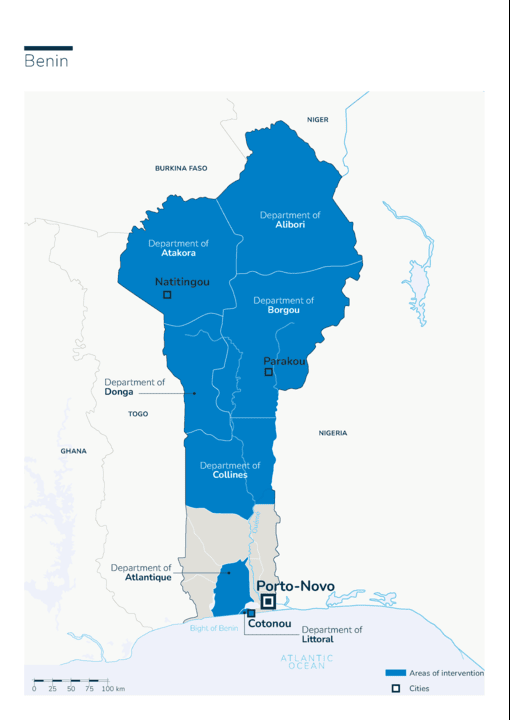
Areas of intervention


concretely
Situation of the country
Benin, a West African country with a population of over 13.4 million, faces major humanitarian and socio-economic challenges whilst experiencing sustained economic growth. Despite rising GDP and estimated growth of 7 per cent in 2026, inequalities and regional crises are taking a heavy toll on the most vulnerable sections of the population.
In recent years, Benin has experienced strong economic growth driven by the services, agriculture and trade sectors. The country stands out in the region for its rigorous fiscal management and structural reforms. However, this momentum is not being felt equally across the entire population, and regional disparities, particularly between the north and the south, remain marked.
The humanitarian situation in Benin has deteriorated in the north of the country due to the spread of violence originating in the central Sahel. By the end of 2025, the attacks by armed groups in the north of the country had caused the displacement of more than 27,000 people within the country and the arrival of more than 29,000 refugees and asylum seekers, according to the United Nations High Commissioner for Refugees. These people, often deprived of their land and livelihoods, struggle to access basic services and humanitarian aid. Natural disasters such as floods exacerbate the vulnerability of communities, destroying crops and homes.
Humanitarian needs are particularly acute for children, women and people with disabilities. The protection and promotion of the rights of people with disabilities, underpinned by the law of September 2017, have been supported by five major implementing decrees, adopted in June 2023, which set out the practical arrangements for inclusion. However, the implementation of key measures remains pending the issuance of further orders. Many difficulties persist, such as access to public infrastructure, education and healthcare, due in particular to a lack of environmental adaptation and the necessary facilities to access various services.
- Population: 13.5 million
- HDI: 0.515 (2023)
- GDP: 19.4 billion USD (2024)
- GDP per capita: ~1,411 USD (2024)