
Ethiopia
HI supports people affected by humanitarian crises by facilitating access to health and rehabilitation services, climate resilience, education, economic inclusion, and armed violence reduction.
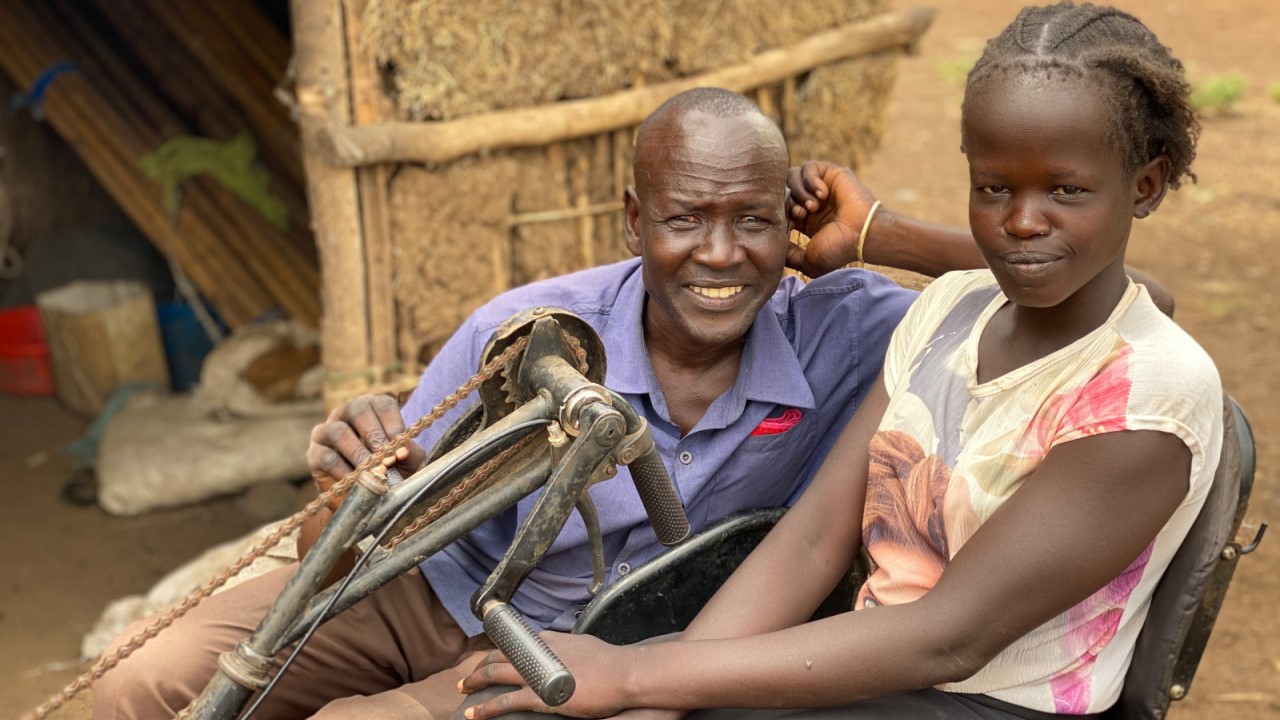
Gambella, 2021. Nyaduoth sits on her tricycle next to her uncle. The tricycle allows her to be mobile and more independent in a world where there are many barriers for a young girl with a physical disability. | © Till Mayer / HI
Actions in process
HI initiated its inclusive education project in the Fafan Zone of the Somali Regional State in 2011, followed by two consecutive five-year programmes (2018–2027). These projects aim to support persons with disabilities, their families, and children with disabilities to achieve better integration into society through the removal of barriers, improved access to income and livelihood opportunities, and strengthened rehabilitation services. HI also supports survivors of war through its victim assistance interventions, promoting their economic inclusion and empowering both survivors and their families.
As part of its commitment to enhancing rehabilitation services, HI is scaling up innovative, technology-based solutions, including the production and fitting of 3D-printed prosthetic and orthotic devices for individuals who have lost limbs. This approach, currently being implemented in Tigray, Somali Regional State, and Addis Ababa, provides an affordable and accessible solution—particularly for beneficiaries in remote and underserved areas—by reducing production time and costs while expanding access to essential assistive devices.
HI also supports survivors of war through its victim assistance interventions, with the goal of promoting economic inclusion and empowering survivors and their families.
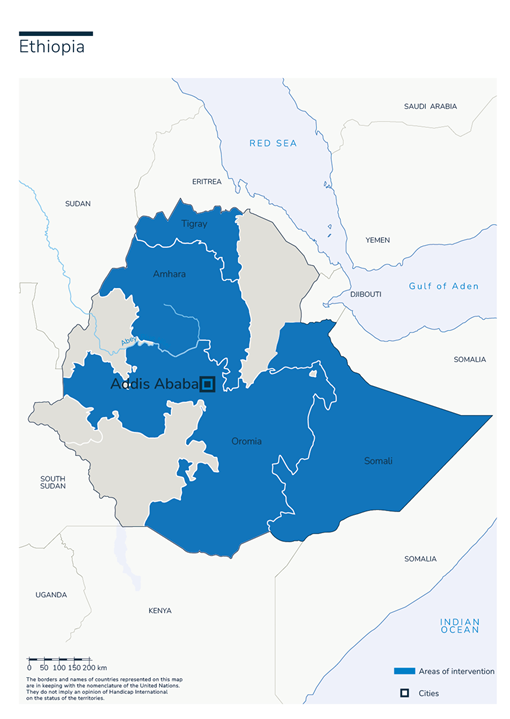
Since 2019, HI has been implementing protection and risk reduction responses in Somali, Oromia, Gambella, Benishangul-Gumuz, Tigray, and Afar regions, targeting drought- and conflict-affected internally displaced persons and refugees.
HI also implemented a project which focuses on capacity building and delivering integrated emergency humanitarian responses, including mental health and psychosocial support (MHPSS).
Currently, HI is implementing explosive ordnance risk education for communities living in contaminated areas of Tigray and Amhara.
- Number of HI staff: 101
- Direct beneficiaries supported by HI in 2025: 52 769 people
- Indirect beneficiaries of HI’s actions in 2025: 233 582 people
- Programme opened in: 1986
Areas of intervention


concretely
Situation of the country
As of March 2026, Ethiopia remains under heightened public health vigilance following the end of the Marburg outbreak in January, which recorded 19 cases and 9 deaths (64% CFR). Efforts continue to focus on early detection, particularly in high-risk areas. At the same time, regions such as Somali, Oromia (including Bale and East Bale), and Afar face an increased risk of cholera and diarrhea, driven by drought, water shortages, and displacement, placing an estimated 70 million people at risk nationwide.
Malaria transmission also remains high—especially in Oromia—contributing to 7.3 million cases and 1,157 deaths in a country where approximately 75% of areas are endemic. Conflict- and drought-affected regions such as Afar, Somali, and Tigray continue to experience outbreaks of measles, dengue, and diarrhea due to low immunization coverage and disrupted health services. Meanwhile, severe acute malnutrition remains widespread, with an estimated 763,879 children requiring treatment, particularly in drought-prone areas.
Heavy rains in eastern Ethiopia during March 2026 have, however, temporarily improved water and fodder availability, providing some relief in affected regions.
Funding cuts in 2025–2026 have significantly reduced humanitarian response capacity in Ethiopia - effectively halving some food assistance programs and leaving a shortfall exceeding $200 million. This has led to the suspension of nutrition services, reduced food rations, and millions of vulnerable people losing access to life-saving assistance, thereby exacerbating hunger, malnutrition, and overall humanitarian conditions.
- Population: 112.37 million
- HDI: 0.497 (2023)
- GDP: USD 112.53 billion
- GDP per capita: USD 1,080