
Kenya
In Kenya, HI is unlocking opportunities for young people with disabilities in five counties and improving access to healthcare, education, and employment for people with disabilities in refugee camps.

Refugees in Dadaab camp, Humanity & Inclusion Kenya | © B. Blondel / HI
Actions in process
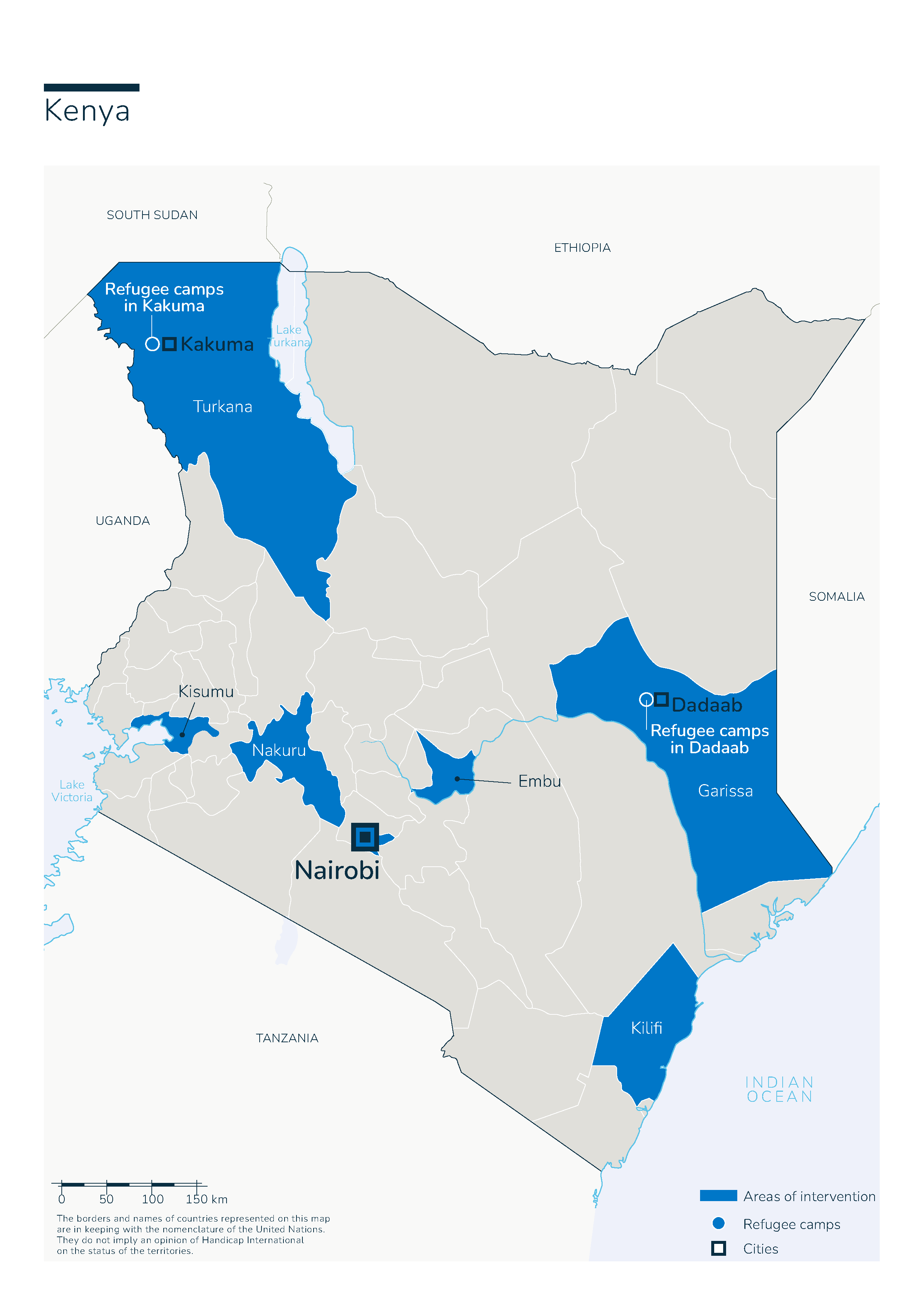
HI strengthens the inclusion, participation, and protection of forcibly displaced persons and stateless individuals in Kakuma refugee camp, with a particular focus on persons with disabilities, older persons, and other persons with specific needs. The organisation seeks to improve access to inclusive services, including physical and functional rehabilitation, and mental health and psychosocial support, while also promoting disability inclusion within local governance and humanitarian systems. HI supports efforts to ensure that both refugee and host communities benefit from more accessible and coordinated services.
The organisation aims also to strengthen inclusive education in Kakuma by improving teachers’ capacity on inclusive learning. Insights from these activities will contribute to the revision of national policy on learners and trainees with disabilities, supporting more inclusive teaching practices at scale.
HI promotes the economic empowerment and inclusion of young persons with disabilities by supporting their access to employment, entrepreneurship, and the local labour market. The organisation targets young people, with a strong focus on women and girls with disabilities, who face additional barriers to education and economic participation. HI supports tailored pathways that combine vocational, technical, and entrepreneurial training aligned with labour market needs, as well as assistance for micro-enterprise development and transitions into work through internships and job placements. The programme also promotes innovation in areas such as digital accessibility and assistive technologies, contributing to greater financial inclusion and long-term economic independence.
- Number of HI staff: 55
- Direct beneficiaries supported by HI in 2025: 40 091 people
- Indirect beneficiaries of HI’s actions in 2025: 200 455 people
- Programme opened in: 1992
Areas of intervention


concretely
Situation of the country
Kenya, a lower-middle-income country and one of the largest refugee-hosting states in Africa, continues to face significant humanitarian challenges driven by recurrent climate shocks, food insecurity, and structural inequalities. Repeated droughts and floods, particularly in arid and semi-arid regions, have severely affected agricultural production, water availability, and livelihoods, increasing the risk of malnutrition and deepening poverty. These climate-related crises are compounded by high levels of inequality and limited access to essential services such as healthcare, education, and social protection, especially for vulnerable populations.
The country hosts a large and protracted refugee population, mainly from Somalia and South Sudan, with many living in long-established camps Dadaab and Kakuma. Humanitarian needs remain high, while funding constraints have reduced food assistance and placed additional pressure on already limited basic services, worsening living conditions for both refugees and host communities.
Persons with disabilities and other at-risk groups are disproportionately affected by these overlapping crises. They often face significant barriers to accessing healthcare, rehabilitation, education, and livelihoods, and are at higher risk of exclusion in both refugee and host community settings. In Kenya, persons with disabilities face also significant social and economic exclusion due to stigma, discrimination, and limited access to employment. As a result, many remain in poverty, while administrative barriers also prevent them from accessing their legal rights and economic benefits.
- Population: 54.27 million
- HDI: 0.628 (2023)
- GDP: USD 147.26 billion
- GDP per capita: USD 2,710