
Mali
In Mali, HI helps build the resilience of communities affected by conflict, promotes an inclusive society and works to bring about a lasting change in attitudes towards disability.

Transporting humanitarian goods by road and by pinnace on the Niger River, from Bamako to Timbuktu. | © T. N'Daou / HI
Actions in process
In Mali, HI operates in a context characterised by a prolonged security crisis, armed violence and population displacement. The organisation aims to meet the urgent needs of the most vulnerable people, particularly women, children, displaced people, older people and people with disabilities, by adopting an inclusive and dignity-centred approach.
HI provides a wide range of services: functional rehabilitation, mental health and psychosocial support, education on the risks posed by explosive devices, victim assistance, inclusive education, and more. The organisation therefore carries out mental health and psychosocial support activities to assist people severely affected by violence, forced displacement and multiple forms of abuse. HI also provides protection services, particularly for survivors of gender-based and sexual violence. The organisation also trains community liaisons within local communities to raise awareness of these issues amongst residents and to identify those in need of specific support.
HI organises awareness campaigns on the risks associated with explosive devices and supports vulnerable populations exposed to them: financial support and assistance in developing sustainable livelihoods, psychosocial support, the provision of commodities, facilitating access to emergency medical care and rehabilitation, and training community representatives on protection issues.
To ensure that all children have access to appropriate, high-quality education, HI is building the capacity of educational staff on the inclusion of children with disabilities. The organisation supports teachers in making their teaching practices more inclusive, works alongside schools to improve the accessibility of facilities, and organises extracurricular activities for pupils with disabilities. HI carries out awareness-raising activities on inclusion within families and communities and strengthens the system of personalised support for pupils with disabilities through training and deploying itinerant teachers.
The organisation is active in the field of economic inclusion, working to promote the social and professional integration of young people with disabilities and change society’s perception of disability. HI supports local initiatives and encourages the development of village savings and credit associations, which serve as tools for community empowerment. The organisation supports young children with multiple disabilities or suffering from malnutrition by providing them with comprehensive care.
Finally, HI works across the country to promote the inclusion of people with disabilities. As one of the few organisations active in this field, HI ensures that the needs of people with disabilities, women, young people and older people are taken into account in projects carried out by its partners and other NGOs.
- Number of HI staff: 76
- Number of direct beneficiaries supported by HI in 2025: 141,637 people
- Number of indirect beneficiaries supported by HI in 2025: 623,294 people
- Programme launch date: 1993
Areas of intervention


concretely
Situation of the country
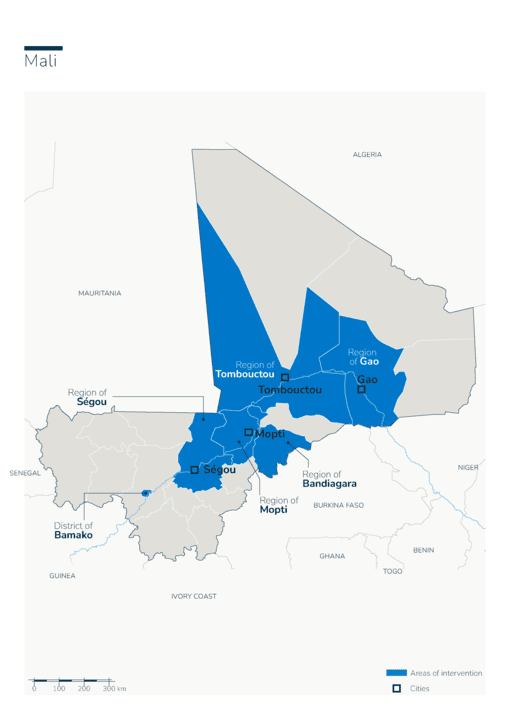
Mali, a country in West Africa, has a population of over 25 million and is facing a complex and persistent humanitarian crisis. In 2026, against a backdrop of insecurity, forced displacement, climate-related shocks and socio-economic difficulties, nearly 5 million Malians are in need of humanitarian aid – one in five people in the country.
Recent years have been marked by a steady deterioration in the security situation in Mali, notably with the spread of armed violence and an increase in attacks against civilians and humanitarian workers. Explosive remnants of war remain a major threat to the population, now also affect the south of the country.
Many civilians, who have been particularly affected by the climate of insecurity, are fleeing the violence. As a result, by the end of 2025, nearly 415,000 people were internally displaced, 58% of whom were children and 30% women.
Furthermore, recurring disasters, such as floods and epidemics, further exacerbate the vulnerability of communities. For instance, the historic floods during the 2024 rainy season affected more than 850,000 people. These extreme weather events disrupt people’s access to livelihoods and contribute to the fact that nearly 4 million Malians are facing persistent food insecurity in 2026, with a high risk of malnutrition, particularly among young children.
Humanitarian needs remain immense: access to water, healthcare and education remains limited for millions of people, particularly women, children and people with disabilities.
- Population: 25.2 million
- HDI: 0.417 (2023)
- GDP: USD 26.8 billion (2024)
- GDP per capita: ~USD 1,094 (2024)