
Togo
In Togo, HI works to improve the living conditions of people in vulnerable situations and people with disabilities, helping to build a more inclusive society.

Students burst out laughing during a participatory theater performance by the association Nyagbe ("the word") at the Lycée Gbodjomé in Goumoukopé. | © A. Surprenant / MYOP / HI
Actions in process
In Togo, the school system is not always sufficiently adapted to meet the needs of children with disabilities. HI has been running a project for the past ten years aimed at ensuring inclusive access to primary and secondary education and developing vocational training for children and young people with disabilities. Working alongside schools and public authorities, the organisation raises awareness of inclusive education and adapted teaching methods. HI trains teachers, supports schools and provides educational resource centres. HI works to ensure that disability is taken into account and that the necessary adaptations are incorporated into government guidelines, to improve access to services.
In the north of the country – a region regularly affected by violence perpetrated by non-state armed groups in the Sahel – HI is committed to strengthening the resilience of displaced people, refugees and host communities. Through a voucher system, the organisation enables each family to purchase the essential goods they need, whilst giving them the freedom to choose the products that best suit their situation. In addition, families receive psychosocial support as well as initiatives to prevent and combat gender-based violence. HI supports community cohesion by creating spaces for dialogue between refugees and host communities and by raising awareness of peaceful conflict resolution. Finally, the organisation promotes employment for young people and people with disabilities, in a context where access to the labour market is difficult for them. To this end, HI organises awareness-raising campaigns, supports young people and people with disabilities with career guidance, and works with job platforms, recruitment agencies and employers to ensure their practices become more inclusive.
The organisation is also committed to promoting and strengthening the rights of people with disabilities, with a particular focus on gender-based discrimination. In a context where women with disabilities face double discrimination, the organisation strengthens their leadership and supports their organisations by building their skills and working to share best practice to improve access to fundamental rights and advance equality.
- Number of HI staff: 36 people
- Number of direct beneficiaries supported by HI in 2025: 54,428 people
- Number of indirect beneficiaries supported by HI in 2025: 205,660 people
- Programme launch date: 1997
Areas of intervention


concretely
Situation of the country
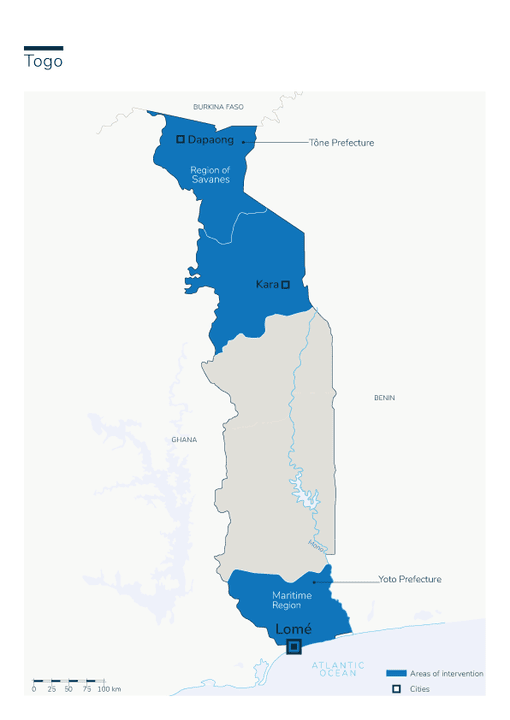
Togo, a West African country with a population of nearly 9.5 million, faces persistent humanitarian and socio-economic challenges, despite sustained economic growth in recent years. Although GDP is rising and there is relative macroeconomic stability, the country remains marked by structural inequalities and increased vulnerability amongst its populations, particularly in border and rural regions. Growth has not led to a significant reduction in poverty or inequality: in 2024, nearly 26% of the population was still living in extreme poverty and disparities in access to basic services between urban and rural areas remain significant.
The regional security crisis, particularly the insecurity in the Sahel, has since 2021 led to forced displacement and the arrival of more than 50,000 asylum seekers and refugees, exacerbating the pressure on local resources and host communities and, in some cases, creating tensions. In August 2025, the Savanes region in the north of the country had more than 225,000 people facing food insecurity.
Furthermore, recurring climate-related shocks such as floods and droughts have undermined livelihoods, whilst malaria and other endemic diseases continue to pose a threat to public health, particularly among children under five. People with disabilities continue to face major barriers to accessing healthcare, education and employment, despite legislative progress and national action plans to promote their inclusion.
- Population: 9.5 million
- HDI: 0.571 (2023)
- GDP: 9.7 billion USD (2024)
- GDP per capita: ~US$1,052 (2024)