

In the disaster areas, few buildings have withstood the shock of the tremors, after the powerful earthquakes that hit northwest Syria.The quake has brought down thousands of buildings and killed thousands of person in a country already severely impacted by decades of war. | © HI partner / HI
Almost 700 patients in 3 days
“We have received 680 patients and performed 150 surgeries in the past three days. The entire 150-member staff has been mobilized since Monday to handle the emergency caused by the earthquake.
The hospital is crowded with patients of all ages: children, women, men… They are all suffering from crush syndrome, amputation, broken bones, damaged muscles and tissues and other injuries caused by falling walls.
We work from 4 o’clock in the morning until midnight. Personally, I have slept only 10 hours in three days.
Many amputation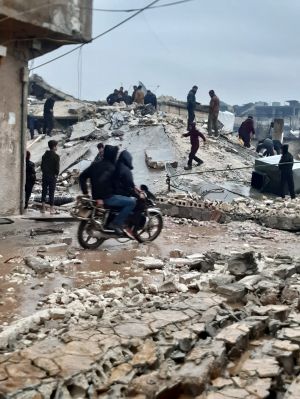
Yesterday, rescue teams had to amputate the leg of a 13-year-old girl who had been trapped for 20 hours in the rubble. It was impossible to remove from the rubble as she was stuck under a wall. They had to amputate her on the spot.
All the patients we have treated since Monday will need long-term rehabilitation, some of them will require prosthetics or orthotics.
For example, we have many patients with external fixator; they will need a long-term follow-up and rehabilitation in order to avoid permanent disability. People with damaged tissues or muscles or open fractures are very long to cure and the risk of infection if very high.
People under shock
Today, the number of cases has decreased slightly as they find lees people under the rubble, but we are receiving more patients from other cities and rural areas.
Most of the people are in shock. Some of them remain silent when you talk to them they are unable to answer anything. Some are disoriented or very stressed...
My teams are also exhausted. I have an experience in war emergencies, and an earthquake is perhaps more terrifying than air raids. It lasts longer. An airstrike and the explosion just last for one or 2 seconds, you are dead or you are alive. The earthquake Monday it was more than one minute. It was really frightening.
My experience of war helps me to cope with the current situation.