

66-year old Nahy sits in a chair outside of her home in the South of Madagascar. | © Parany Photo / HI
Lack of rainfall increases food insecurity
Several consecutive years of insufficient rainfall in the south of Madagascar have contributed to one of the worst droughts in its history and a growing situation of food insecurity across communities.
“Life is not like it used to be,” says 66-year old Nahy, who lives in a village classified as ‘severely’ impacted by the drought. “Things are getting harder. Before, there were abundant rains and we could cultivate crops. Today, there is no more rain and we’re suffering from it.”
“I have six children and 10 grandchildren,” says Nahy. “I take care of the entire family of 16 people alone because my husband and other family members have all passed away. The youngest children live with me in my tiny house, and we all eat and sleep together on the floor.”
Receiving food assistance from HI
“We need to cook 10 kapoaka of rice (about 3 kg) per day to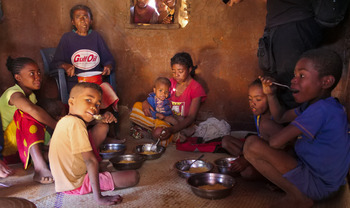 feed everyone. We don't have enough food, we run out of what we can afford after just one week. We have to walk over a kilometer away to get water. My wish is that we can have enough food to last us each month so that we can have a better life.”
During a door-to-door evaluation, Nahy met with Victor, an HI partner community agent living in her region. He learned about Nahy’s situation and connected her with HI to receive monthly food provisions for her family.
“During the distributions I receive 30 kg of rice, 2.5 liters of vegetable oil, and 4.5 kilos of beans each month,” Nahy says.
Supporting the most vulnerable
Persons living with added vulnerabilities such as disabilities or low incomes face even further difficulty providing for themselves and their families during times of crisis. As crops fail to grow, food becomes scarce and prices also increase. Nahy lives with a disability that affects the use of her hands and prevents her from working.
“Due to my disability, I cannot cook meals by myself and I need help for small tasks like getting dressed in the morning. My children and grandchildren are the ones who cook for us, because it causes me too much pain. I am not able to work, and my children cannot find jobs here, so we cannot afford the little food available.”
The project aims to provide emergency food assistance[1] to persons with disabilities and their households (approximately 7,000 people) living in the Atsimo Andrefana region of Madagascar to alleviate the negative impacts of the drought. The same project also provides rehabilitation services known as “stimulation therapy” to undernourished children to help prevent developmental delays and disabilities associated with a lack of nutrition. 320 children have already received stimulation therapy, and 350 others have been identified for the coming months.
 GREEN Initiative: HI is committed to reducing the adverse effects of climate change on vulnerable and marginalized populations worldwide. We help communities prepare for and adapt to climate shocks and stresses, and we respond to crises magnified by environmental factors. Applying a disability, gender and age (DGA) inclusion lens across all our actions, we advocate for practitioners and policy-makers to embed DGA in their climate work as well. HI is also determined to reduce its own ecological footprint by adapting and implementing environmentally conscious approaches to humanitarian action.
[1] Beneficiaries can choose between monthly in-kind food donations, or financial support of 100,000 AR per month