


HI rehabilitation specialist, Violette, wraps bandages around a patient burned in an explosion. Lviv, Ukraine. | © HI
Rehabilitation support for war-related injuries
“We are seeing a lot of burns,” says Violette Van Bever, HI Emergency Rehabilitation Manager in Ukraine. “We have quite a lot of hand and face injuries in particular since these areas are often exposed. Patients are also coming for amputations. In one of the hospitals where we’re working we have seen 20-30 people with amputations.”
As armed violence continues across Ukraine, people are increasingly exposed to explosions, burns and trauma injuries. While hospitals are still treating patients of all kinds, war-related injuries have been increasing.
“War-related patients are coming in waves, so it can be quite irregular,” Violette explains. “You can have no new patients for a few days, and then you will have 10 come in at once because they are being transferred from the East.”
HI is working in Chernivtsi, Dnipro, Vinnytsia, and Lviv to support people across the country affected by the war. While war-related injuries such as burns and amputations are the focus of HI’s rehabilitation project in Lviv and Dnipro, further west the focus is more general.
“In Chernivtsi, we’re not seeing war-wounded patients,” says HI Emergency Rehabilitation manager Virginie Duclos. “Our work there targets people with chronic diseases and conditions who have been displaced by the conflict and do not have access to their regular care.”
Without support, patients risk complications
“Both amputee and burn patients require long-term follow-up, for up to a year, to keep complications from developing,” says Violette. “We have already seen some patients with complications, mainly retraction and loss of range of motion. They stay bedridden for too long, sometimes for a month without moving, and they lose muscle strength as a result.
We are foreseeing big challenges in long-term follow-up. Rehabilitation at the community level is quite unknown here, so when patients leave the hospital, they do not have any way to continue their care.”
In many of the hospitals where HI is intervening, no rehabilitation services are offered. When hospitals are able to provide rehabilitation services, their ability to care for patients is limited due to insufficient staff and little to no early rehabilitation. HI specialists are working alongside hospitals to strengthen and reinforce the capacity to care.
HI provides specialized staff training
To reinforce staff capacity and improve rehabilitation care for patients, HI 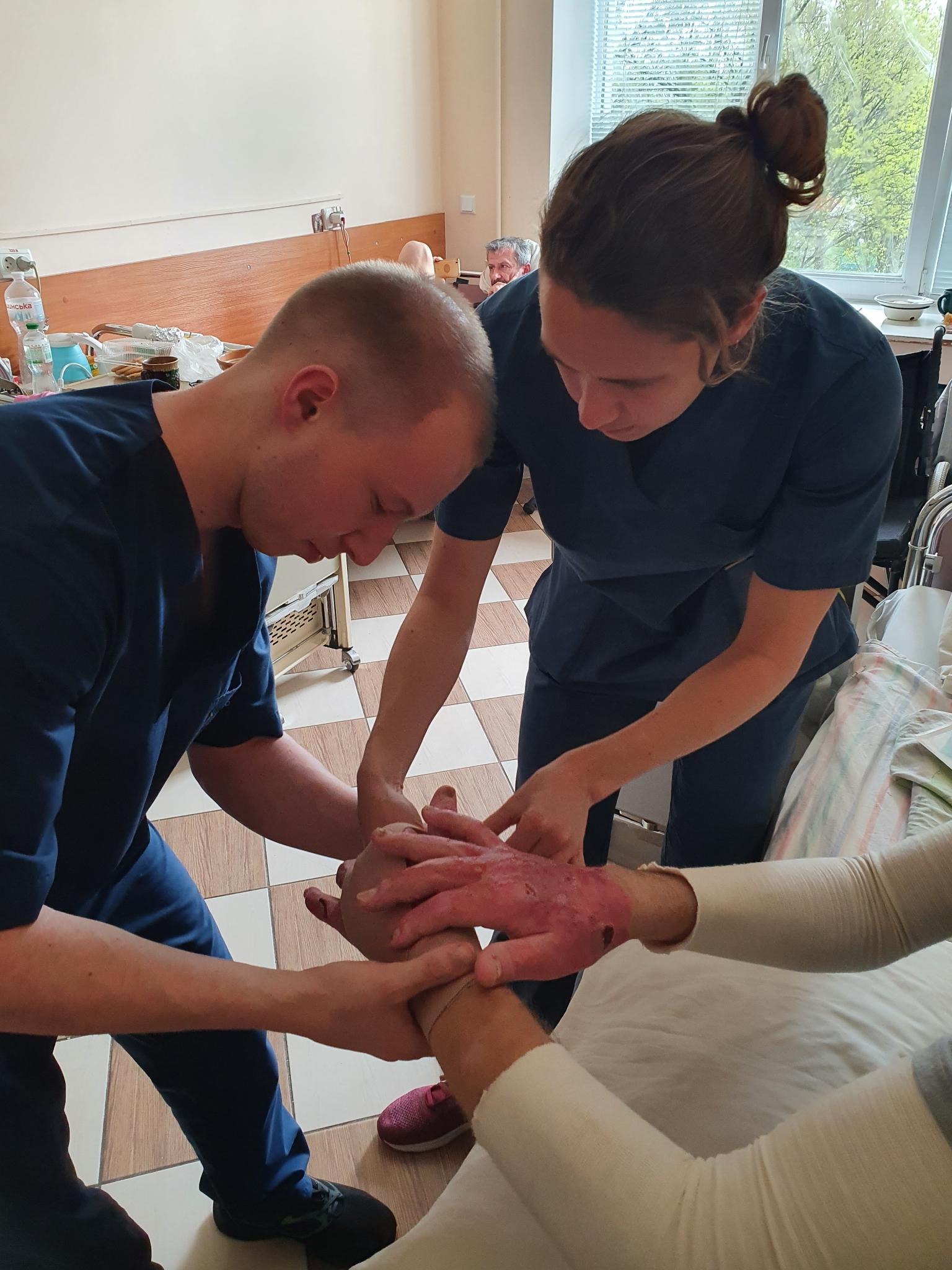 rehabilitation specialists have been providing theoretical and on-the-job training to physiotherapists, occupational therapists, students and physical rehabilitation medical doctors (PRMs).
“It’s important for the medical approach to understand and include the importance of rehabilitation in their healing process,” says Virginie. “If patients are told by their doctors not to move, they will not listen to a rehabilitation specialist who tells them the opposite.”
Over the past week alone, around 30 medical staff members were trained in caring for trauma and war-related pathologies in Dnipro.
“One of our patients has also been advocating to his doctors for us. Since he started physical therapy, he is so pleased with how well his burned hands are healing, and how flexible his fingers are.”
Mental health support of growing concern
“We are also seeing a lot of psychological distress even from the staff,” Virginie says. “They are working like crazy, they are seeing a lot of war-wounded patients and they are also suffering from this war. Some of them have family in the east and they are worried. It’s very often that the staff are talking to us and we see tears in their eyes.”
Despite the difficult times, many have been mobilizing to support humanitarian efforts.
“We see a lot of motivated people” Violette explains. “A lot of our staff have been volunteering outside of work to help displaced persons. But their capacity to give support is running out. In the beginning, they were spending their own money to transport people and provide help - now they have started to reach their financial limits. We need skilled NGOs with systematic approaches to put plans in place and take the burden off of those affected by the war.”