

To help the most vulnerable people, HI has deployed a team of nine expatriate emergency. | © B. Almeras / HI
«We don’t currently have the financial resources to provide an adequate response to a disaster of this magnitude. Needs are enormous and varied. Our teams are making every effort to meet people’s essential needs, but we don’t have the means to ensure people are able to get through this latest ordeal, or to help them recover again,” Hélène Robin, head of HI’s emergency response.»
Hélène Robin, coordinating the emergency operations from Humanity & Inclusion’s head office
Deployment of mobile teams
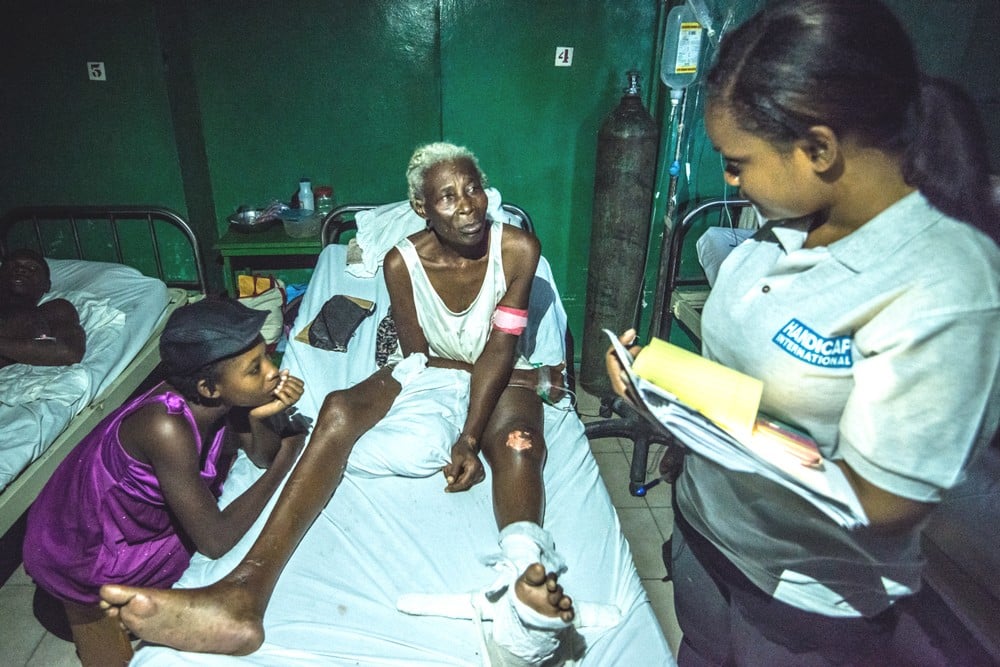
Two teams of three experts have been deployed to the city of Les Cayes to case-manage the injured. Consisting of a project manager specialised in special needs (particularly rehabilitation), a psychological support project manager, a physiotherapist and a social worker, each of the teams assessed the state of hospitals and rehabilitation services in order to provide support to local facilities. Each team also supplies mobility aids (wheelchairs, crutches and walking frames), provides basic rehabilitation care to people injured by Hurricane Matthew and offers psychological support to help victims overcome their trauma.
“Haitians are very resilient, but a lot of people have been psychologically shaken by the hurricane. They need to express their feelings as part of their therapy. We’re setting up discussion groups as a first step to helping people overcome their trauma,” explains Fanélie Rabanx, head of the psychosocial project.
Distributions of emergency kits
HI is organising the distribution of emergency kits containing a toolbox, rope, fastenings, sheets, among other items, so that affected people can build shelters and live in decent conditions again. The organisation also plans to distribute hygiene kits and essential household items (including jerrycans and torches), in order to limit the spread of epidemics such as cholera, with the number of infections already high in communes including Chardonnières, in the department of Sud.
“When the hurricane hit our neighbourhood, Fondrède, I really thought it was all over. The roof of our home fell on top of us and we escaped to our neighbour’s house. We didn’t stay long because we didn’t want to be a burden on them. Today, we’re back, but we don’t have a roof or any crops. We’ve lost everything,” explains Inès Virgile, 32, mother of five children.
Logistics platform
“Our priority is to enable casualties, families who have lost everything, and the most isolated people to access humanitarian services,” adds Hélène Robin. Due to problems accessing certain areas affected by the hurricane and in order to access the most isolated communities, the organisation has beefed up its team of logistics specialists. It will organise the transport of humanitarian aid by sea using the services of local carriers with boats, or by road. The aim is to enable humanitarian actors working in isolated regions to receive supplies of items for the local population and to distribute them to people who need them, even the most isolated.
Humanitarian situation in Haiti
• Number of people affected by Hurricane Matthew: 2.1 million
• People in need of humanitarian assistance: 1.4 million
• Displaced people: 175,500
• Homes destroyed: 146,000
© B. Almeras / HI