

Harith in his family’s tent in Hasansham. | © E. Fourt / Handicap International
Today, Handicap International’s team is visiting nine-year-old Harith to provide him with physiotherapy care. “He was injured several months ago, but he’s still in pain and finds it hard to walk,” explains the organisation’s physiotherapist, Mohammad. “My job is to get him back on his feet. This is our third physiotherapy session together.”
Metal external fixations come out from Harith’s leg, testifying to the severity of his accident. “They began bombing our neighbourhood late last year,” explains his father, Younes. “One morning, we tried to flee the city by car but a rocket fell on us. My brother died instantly and my son was seriously injured. Our neighbours rushed us to hospital and we stayed there for a week.” Harith’s accident marked the beginning of the family’s long ordeal. “When we left the hospital, we returned to an area not far from home, but the following month, there was more bombing, so we had to flee again. We were so scared that we moved from place to place for weeks, in order to avoid the bombing. And then we finally came here.”
Harith now lives with ten family members in a tent, in Hasansham camp. “Life is tough here,” adds his father, “but we’re safe and that’s the most important thing.” The boy’s mother, Nada, has found it harder to accept her new life. “Things were really good before. It feels like the bridge between our past and present lives was bombed too,” she says, visibly moved.
As his parents chat with Diana, Handicap International’s social worker, Harith and the physiotherapist do more rehabilitation exercises. Although Harith was injured several months ago, every movement is still a challenge and, despite Mohammad’s encouraging words, the strain shows on the boy’s face. To take his mind off the pain, Diana and Mohammad ask him to do a drawing. The social worker takes out a pencil and a notebook and chats with Harith. The young boy sketches a house on a sheet of paper while The physiotherapy session comes to an end and Harith puts the finishing touches to his drawing. “We draw at the camp school too,” he says with a smile. Harith had never been to school before he arrived to Hasansham. “My favourite subject is science” , he adds. “I think he should be able to walk
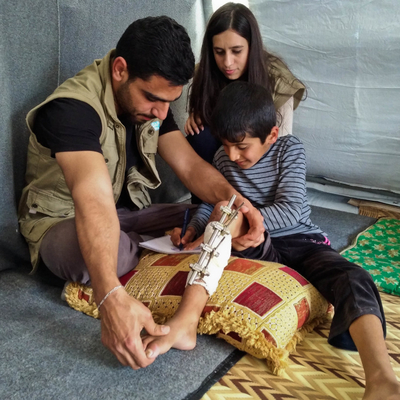 Harith does a drawing during his physiotherapy session. © E. Fourt / Handicap International